Is the Moon Drifting Away from Earth? Yes — 3.8 cm Every Year
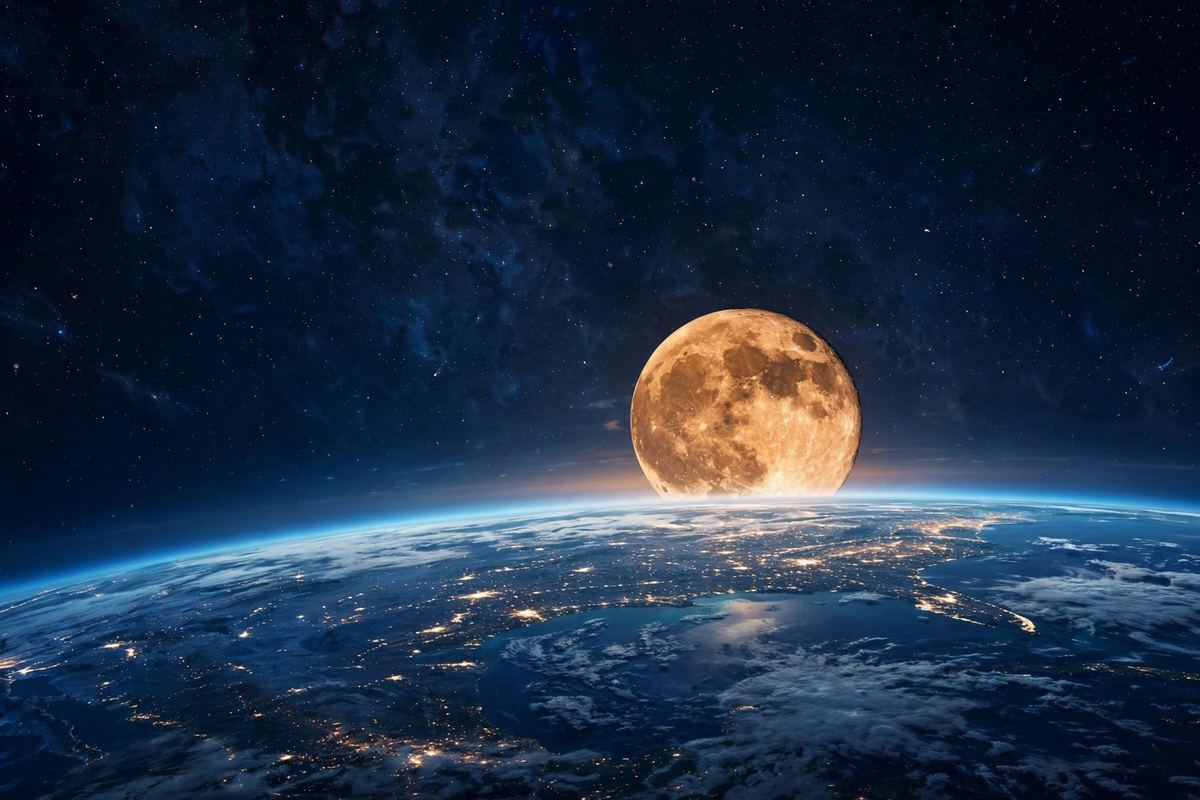
The Moon is leaving us — slowly, but measurably. Every year, the average distance between Earth and the Moon grows by about 3.8 centimetres, roughly the speed your fingernails grow. Over a human lifetime, that adds up to around three metres.
How do we know? Mirrors on the Moon
This is not a guess. During the Apollo missions, astronauts left special mirrors called retroreflectors on the lunar surface. Scientists on Earth fire lasers at these mirrors and time how long the light takes to bounce back. Because light travels at a known speed, the round trip gives the distance to within millimetres.
Decades of these measurements — a technique called lunar laser ranging — confirm the drift with extraordinary precision.
Why is the Moon moving away?
The culprit is the tides. The Moon's gravity pulls on Earth's oceans, creating tidal bulges. Because Earth spins faster than the Moon orbits, friction drags those bulges slightly ahead of the Moon. The bulges then gravitationally tug the Moon forward, adding energy to its orbit and pushing it outward — while Earth's own rotation slows down a tiny fraction.
This has been happening for about 4.5 billion years. Billions of years ago, the Moon was much closer and appeared far larger in the sky — and Earth's days were considerably shorter.
Will the Moon ever leave completely?
Not in any timeframe that matters. The drift will continue for billions of years, but long before the Moon could escape, the Sun will have swollen into a red giant and transformed the inner solar system. For now, the Moon remains firmly — if slightly less firmly — ours.
More mind-blowing facts

Is a Day on Venus Longer Than Its Year?
Venus spins so slowly that one day there (243 Earth days) lasts longer than its entire year (225 Earth days).

Why Is Wombat Poop Cube-Shaped? The Only Animal That Does It
The wombat is the only animal on Earth known to produce cube-shaped droppings — and scientists finally figured out how.

Oxford University Is Older Than the Aztec Empire
Teaching at Oxford began by 1096. The Aztec capital wasn't founded until 1325 — Oxford is older than the Aztec Empire by centuries.